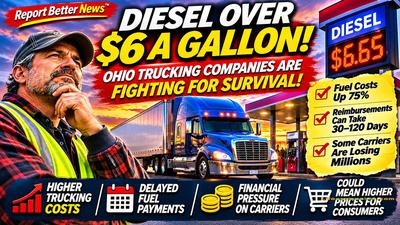
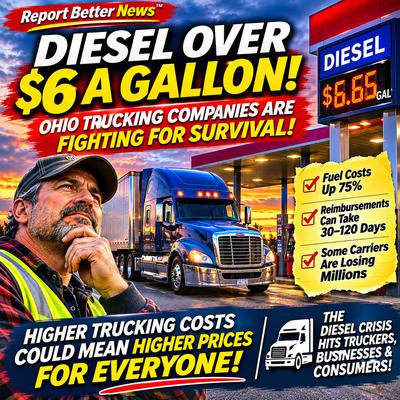
Diesel Over $6 a Gallon! Ohio Trucking Companies Are Fighting for Survival!
by TRUCKERS VA
(UNITED STATES)

Diesel Over $6 a Gallon! Ohio Trucking Companies Are Fighting for Survival!
Imagine pulling into a truck stop, filling your tanks, and watching hundreds of dollars disappear before you've even delivered your next load. Now imagine doing that day after day while customers are still expecting yesterday's transportation rates.
Welcome to the reality facing many trucking businesses in Ohio.
Diesel prices have climbed above $6 per gallon, putting enormous financial pressure on trucking companies already struggling through a prolonged freight recession. And according to industry leaders interviewed by The Columbus Dispatch, some businesses are running dangerously low on cash.
Here's the problem: Trucks still need fuel, freight still needs to move, and the bills don't wait for better economic conditions.
Diesel Prices Are Crushing Trucking Budgets
In October 2026, Ohio diesel prices averaged approximately $6.65 per gallon, according to reporting by The Columbus Dispatch. That's a substantial jump from the $3 to $4 per gallon range some trucking companies had originally budgeted for the year.
National diesel prices also reached a record average of $6.53 per gallon on September 21.
For trucking companies operating dozens or hundreds of vehicles, those increases can translate into enormous additional expenses.
Thomas Balzer, president and CEO of the Ohio Trucking Association, described the situation as extremely difficult, noting that trucking companies had already begun going out of business.
And here's the frustrating part: A truck doesn't get to skip its fuel bill because freight rates aren't cooperating.
The Fuel Surcharge Problem: Getting Paid Back Can Take Months
You might think trucking companies can simply increase their prices when diesel gets expensive.
Unfortunately, it isn't always that simple.
Many transportation contracts establish rates in advance, sometimes for multiple years. Fuel surcharges help carriers recover some of the additional expense, but those reimbursements aren't necessarily immediate.
Continental Express, a trucking company based in Sidney, Ohio, reported that its fuel costs were up 75% compared with the previous year.
Kiera Sullivan, the company's general counsel and shareholder, explained that fuel surcharge reimbursements can take anywhere from 30 to 120 days, and sometimes three to four months.
Think about that.
The trucking company has to purchase diesel today, operate its trucks today, and deliver the freight today. But it might not receive the corresponding fuel reimbursement for months.
That's a serious cash-flow problem.
It's like being expected to pay your mortgage, electricity, and groceries now, while your paycheck is somewhere in the mail taking the scenic route.
The Trucking Industry Was Already Struggling
The diesel crisis didn't arrive at a particularly convenient time.
According to Ohio trucking industry leaders, the industry was already dealing with a four-year freight recession.
Following the pandemic-era shipping boom, freight demand eventually returned closer to normal. Meanwhile, many carriers were competing for available loads, putting downward pressure on transportation rates.
Some trucking businesses were losing millions of dollars year after year, according to Balzer.
Just when transportation rates were beginning to improve, diesel prices started climbing dramatically.
In other words, the industry was trying to recover from one financial punch when another one landed.
Will Consumers Eventually Pay More?
Probably, at least in some cases.
Trucking is
a critical part of the American supply chain. Thomas Balzer noted that more than 80% of finished products in the country are delivered by truck at some point in the supply chain.
Think about your grocery store, local restaurant, hospital, hardware store, or favorite online retailer.
Much of what reaches those businesses has spent time riding in a truck.
When transportation companies face higher operating costs, those expenses can eventually make their way into the prices businesses charge customers.
That means expensive diesel isn't just a trucking problem. It can become a household budget problem, too.
Ohio Tried to Provide Some Relief
Ohio lawmakers passed a temporary fuel tax reduction intended to provide some relief.
The measure, signed by Governor Mike DeWine, reduced the state's diesel fuel tax by 47 cents per gallon for 90 days beginning October 4, 2026.
While that offers some breathing room, it doesn't eliminate the underlying problem of expensive fuel, delayed reimbursements, and transportation contracts that may not adjust quickly enough.
For many trucking businesses, relief at the pump is welcome. But keeping the business financially healthy requires more than a temporary tax reduction.
What Can Trucking Businesses Do?
For owner-operators and fleet managers, this situation is a reminder that controlling expenses and understanding your numbers are more important than ever.
- Know your cost per mile: Calculate what it actually costs to operate your truck before accepting a load.
- Review fuel surcharge agreements: Understand how fuel increases are handled in your contracts.
- Watch payment schedules: Delayed reimbursements can create cash-flow problems even when a load appears profitable.
- Plan fuel purchases: Compare prices and use legitimate fuel discounts where available.
- Explore additional income: Consider opportunities that can diversify your income without distracting from safe and responsible driving.
The Bottom Line: Trucking Can't Run on Empty
Ohio's trucking industry is facing a serious financial challenge.
Diesel prices above $6 per gallon, delayed fuel reimbursements, and years of pressure on freight rates have created a difficult environment for carriers.
And while larger businesses may have more financial reserves to weather the storm, smaller operators can have much less room for error.
The trucking industry keeps America moving. But the people and businesses responsible for delivering everything from groceries to building materials need to be able to afford the job.
Here's the big question: If diesel stays above $6 per gallon, how many trucking businesses can realistically survive without higher transportation rates?
We want to hear from drivers, owner-operators, and trucking business owners. Are fuel prices affecting your operation? Share your experience.
Looking for Ways to Build Additional Income?
Trucking can be rewarding, but relying on just one source of income can leave your finances vulnerable when the industry gets tough.
If you're already in trucking and want to explore additional income opportunities, visit TruckersSideHustle.com.
Discover ideas that could help you think beyond the driver's seat and build additional opportunities.
Stay informed. Protect your business. Watch your costs. Keep those wheels turning!
Sources: The Columbus Dispatch, Nathan Hart, "Ohio trucking companies face crisis amid soaring diesel costs," October 2, 2026; and "Reporter Nathan Hart covers transportation, northwest suburbs for The Dispatch," November 8, 2026.


